

Choosing a commercial space is a significant business milestone. However, before executing a contract, understanding Victorian property law is essential. Signing an unfavourable agreement results in significant financial liabilities.
The primary confusion for tenants lies in comparing a retail lease vs. a commercial lease structure. Choosing the wrong setup impacts your operating costs, legal protections, and long-term business flexibility.
While both represent a business lease agreement, they operate under separate legal frameworks. Misinterpreting your classification can bind your company to restrictive terms. Understanding the difference between retail and non-retail business leases ensures your commercial interests remain protected under Victorian law.
What is a Commercial Lease?
Commercial leases apply to properties used for non-retail business activities, such as industrial warehouses, logistics hubs, wholesale centres, or corporate offices.
Under Victorian common law, these setups favour contractual freedom. Rights and obligations depend heavily on the specific terms negotiated between the landlord and tenant. Because regulators assume both parties possess equal business experience, you must establish your own commercial tenancy terms directly within the contract.
Key Consideration: Standard commercial agreements provide very few automatic statutory protections. If a right is not explicitly drafted into your contract, the law will not step in to protect you later.
What is a Retail Lease?
A retail lease is a highly regulated tenancy governed by the Retail Leases Act 2003 (Vic). This framework applies to premises where goods or services are sold directly to the ultimate consumer. Clothing boutiques, hair salons, medical clinics, and cafes all fall under this category.
Because independent business owners often negotiate against large property developers, Victorian legislation regulates these agreements to balance bargaining power. Landlords must follow strict retail leasing obligations to protect tenants from unfair expenses.
Key Difference 1: The Mandatory Lease Disclosure Statement
A fundamental compliance requirement under Victorian retail law is the provision of a lease disclosure statement.
The landlord must legally provide this document to the tenant at least 14 days before entering into the lease. It serves as an official summary of all financial liabilities, including base rent, review mechanisms, and estimated outgoings.
Depending on the circumstances, a tenant may have legal remedies if the disclosure statement is not provided or contains material inaccuracies. Conversely, commercial tenancies do not carry a statutory disclosure requirement, meaning tenants must locate all hidden costs within the main contract.
Key Difference 2: Outgoings and Legal Cost Allocations
Unexpected operational costs can disrupt a business budget. Expense allocations vary significantly when comparing retail and commercial leases.
Retail Lease Protections
The Retail Leases Act 2003 (Vic) prevents landlords from passing specific capital expenses on to retail tenants. Landlords cannot recover their legal drafting fees from the tenant, nor can they pass on land tax or structural building repairs.
Commercial Lease Allocations
When finalising commercial tenancy terms, landlords routinely pass all building outgoings to the tenant via a “net lease.” Under this structure, you are often held liable for the landlord’s legal drafting fees, building insurance, land tax, and ongoing structural maintenance.
Key Difference 3: Lease Durations and Rent Reviews
Occupancy lengths and annual rent adjustments vary significantly across both lease categories.
- Retail Leases: To provide operational stability, Victorian law generally mandates a minimum five-year term (including the initial term plus options). Rent review structures are tightly regulated; landlords cannot use “whichever is higher” clauses to maximise increases.
- Commercial Leases: There are no statutory minimum terms. A contract can be executed for any duration. Rent increases are entirely contractual and can be tied to fixed percentages, the Consumer Price Index (CPI), or market valuations without legislative restrictions.
Need an expert lawyer to review your business lease draft before you sign?
Can Commercial Lease Terms Be Negotiated?
Many business owners assume lease agreements are rigid, unchangeable documents. In reality, lease conditions are highly negotiable before signing. Rent review frequencies, maintenance boundaries, fit-out contributions, renewal options, and make-good terms can all be adjusted to protect your cash flow and limit future operational risk.
Visual Breakdown: Retail Leases Compared with Commercial Leases
The table below outlines how these two structures compare under Victorian legislation
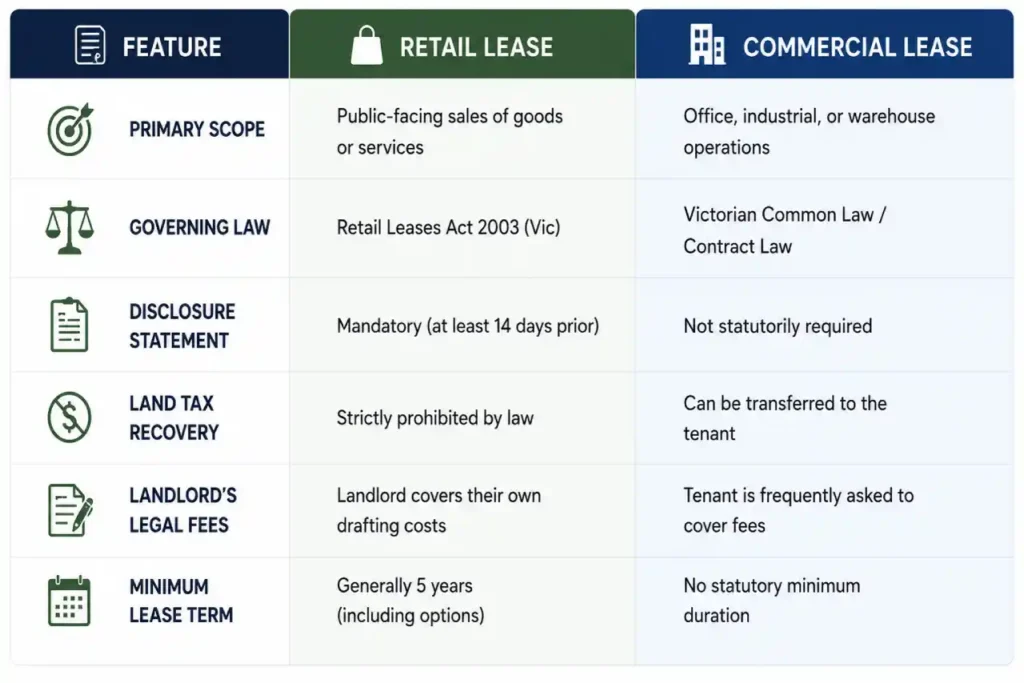
What Tenants Should Check Before Signing a Business Lease
Reviewing critical provisions helps prevent severe compliance vulnerabilities. Before executing your contract, analyse this checklist of what tenants should check before signing a business lease:
- Permitted Use Clause: Ensure the definition covers your exact operations so you are not restricted from expanding services later.
- Fit-Out and Refurbishment: Clarify who pays for internal structural installations and who retains ownership of fixtures upon departure.
- Demolition and Relocation: Check whether the landlord has the right to end the lease early, redevelop the property, or relocate your business during the lease term.
- Make-Good Obligations: Check your legal requirements for restoring the space to a bare shell at lease expiry.
If you are uncertain about any provisions, engaging an experienced commercial lease agreement lawyer to review and negotiate your lease before signing can help reduce future legal and financial risks.
Legal Risks in Retail and Commercial Property Leases
The liabilities associated with commercial real estate are substantial. The main legal risks in retail and commercial property leases usually arise when the lease is incorrectly classified.
If you execute a commercial contract believing you are protected by retail regulations, you remain exposed to unchecked outgoings and structural repair liabilities. Conversely, landlords who fail to recognise a retail tenancy face statutory penalties, rendering their clauses for recovering land tax or legal fees legally void. Evaluating these distinct frameworks early eliminates structural vulnerabilities.
Conclusion: Victorian Property Expertise with VK Lawyers
Differentiating between retail and non-retail business arrangements requires a precise understanding of Victorian property statutes. Because a business lease agreement represents a major financial commitment, navigating these contracts without tailored assistance is highly discouraged.
Whether you require assistance reviewing complex commercial tenancy terms or verifying that a landlord is fulfilling their statutory retail leasing obligations, professional oversight is essential. Seeking legal advice before signing a lease can help you understand your rights, identify potential risks, and negotiate terms that better suit your business objectives. The commercial property team at VK Lawyers can assist you in reviewing, negotiating, and formalising your commercial agreements in accordance with Victorian law.
Frequently Asked Questions:
How is a retail premises officially defined in Victoria?
In Victoria, a retail premises is a space used wholly or predominantly for the sale or hire of goods, or the provision of services, to an ultimate consumer. This applies to traditional shops, restaurants, and specific service-based firms.
Can a Victorian landlord pass land tax on to a retail tenant?
No. Under Section 50 of the Retail Leases Act 2003 (Vic), any clause trying to make a retail tenant liable for land tax is legally void. Landlords must cover their own land tax liabilities.
What happens if a tenant needs to exit a business lease agreement early?
Exiting early requires negotiating a surrender of the lease or finding an appropriate party to assign the lease to. If you walk away without an agreement, you remain liable for rent until the lease expires or a replacement tenant is formalised.
Is a disclosure statement required if a retail lease is renewed?
Yes. When exercising an option to renew a retail lease, or when a brand new renewal is negotiated, the landlord must provide an updated statement within the statutory timelines mandated by Victorian law.
Why does Victorian law enforce stricter rules for retail tenancies?
The Victorian framework imposes strict rules to ensure upfront cost transparency, ban hidden outgoings, and offer baseline security of tenure to smaller operators dealing with large property developers.
Can a retail lease become a commercial lease?
Yes. If the core activity conducted on the premises shifts, such as an administrative office (commercial) opening its doors to provide direct walk-in services to the general public, the lease classification changes. Whether the Retail Leases Act 2003 (Vic) applies depends on the nature of the premises and the circumstances of the tenancy. Legal advice may be required where the classification changes.